


Marble Temple & Marble Mandir for Home: The Complete Buyer’s Guide

Introduction: Why a Marble Temple Belongs in Your Home
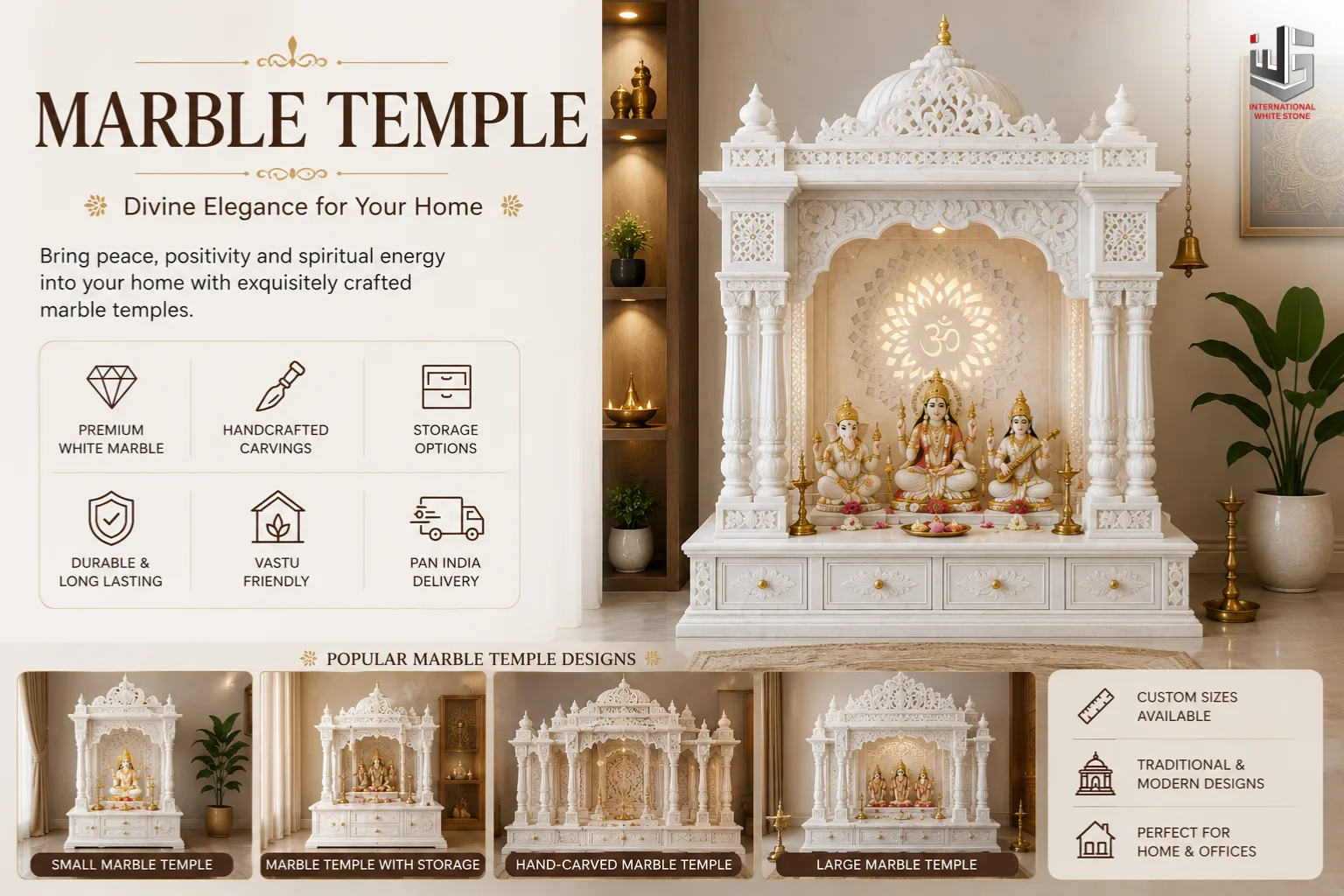
A marble temple for home is more than a piece of furniture it is the spiritual heart of your living space. Whether you call it a mandir, pooja ghar, or devghar, choosing the right marble mandir for home shapes how your family connects with daily worship.
Marble has been the material of choice for sacred spaces for over 2,000 years from the temples of Rajasthan to the shrines of South India. Today, that same timeless stone brings sanctity, elegance, and durability directly into your home.
This guide covers everything you need to make a confident, informed decision: design styles, material grades, vastu considerations, sizing, care routines, and expert tips from decades of experience in stone craftsmanship.


Why Marble Is the Gold Standard for Home Mandirs
Spiritual and Cultural Significance
In Hindu tradition, marble specifically white marble symbolizes purity, clarity, and divine energy. The Makrana white marble used in the Taj Mahal is the same stone widely preferred for white marble mandir for home installations. Its natural brightness is considered auspicious and is believed to amplify positive vibrations in a pooja space.
Practical Durability
Unlike wood, which warps with humidity, or MDF, which swells near incense and water, marble:
- Does not absorb moisture
- Resists heat from diyas and agarbatti
- Maintains its finish for decades with minimal maintenance
- Is hypoallergenic and easy to sanitise after daily rituals
Aesthetic Versatility
Marble integrates seamlessly with modern, traditional, and transitional interiors. A premium marble temple for home can serve as a statement piece in a minimalist apartment or harmonize within an ornately decorated traditional home with equal grace.
Types of Marble Used in Home Mandirs
Not all marble performs equally. Understanding grades helps you invest wisely.
| Marble Type | Origin | Best For |
|---|---|---|
| Makrana White | Rajasthan, India | Classic mandirs, hand-carving |
| Italian Statuario | Carrara, Italy | Luxury modern designs |
| Morwad White | Nagaur, India | Budget-friendly, clean finish |
| Albeta (Beige) | Rajasthan, India | Warm-toned, contemporary pooja rooms |
| Black Marquina | Spain | Accent panels and borders |
Expert recommendation: For a traditional indoor marble temple design, Makrana White (AAA grade) is the best choice. It carves with exceptional sharpness, holds detail for generations, and is authentically Indian in its heritage. For a contemporary look, Italian Statuario with minimal carving produces striking results.
Popular Marble Mandir Designs for Home
1. Single-Tier Flat Mandirs
Ideal for apartments and compact spaces. These sit on a shelf or wall-mounted bracket. Dimensions typically range from 18″×12″ to 30″×18″. Clean lines, minimal carving, and a single deity platform make them practical without sacrificing sanctity.
2. Two-Tier Shikhara Mandirs
The most traditional style, featuring a pointed spire (shikhara) on top. Two separate platforms allow placement of primary and secondary deities. This is the classic marble mandir for home style seen across North India. Height ranges from 3 to 5 feet.
3. Walk-In Pooja Room Units
Floor-to-ceiling marble installations designed for dedicated pooja rooms. These include built-in storage for puja items, jaali (lattice) screens for incense diffusion, and sometimes back-lit panels. A luxury marble temple for pooja room of this type is a permanent architectural feature.
4. Customized Marble Temple Designs
Many craftspeople in Jaipur and Agra specialize in customized marble temple design, where you specify the size, deity configuration, carving motifs, and architectural style. Typical lead time: 4 to 8 weeks. Customization allows you to match the marble to your existing flooring or countertop.
5. Modern Minimalist Panels
Flat-cut marble panels with laser-etched or sandblasted deity images, set into a contemporary frame. Popular with urban buyers who want spirituality without elaborate ornamentation.
Vastu Guidelines for Placing Your Marble Mandir
Placement matters as much as the mandir itself. Following vastu shastra ensures the pooja space supports positive energy flow.
Recommended directions:
- Northeast (Ishan Kona): Most auspicious; morning sunlight reaches the mandir naturally
- East: Acceptable; the rising sun direction aligns with morning prayers
- North: Suitable for Kuber (wealth) deities
Directions to avoid:
- South and southwest are traditionally avoided for pooja spaces
- Never place the mandir inside a bedroom or directly facing a bathroom wall
Height: The base of the mandir should be at least 2 feet from the floor. Ideally, the main deity should be at eye level when you are seated on the floor in prayer.
Material alignment with vastu: White or light-coloured marble in the northeast corner amplifies the water element energy of that zone, which is considered highly beneficial.
How to Choose the Right Size
Size selection depends on three factors:
- Available space – Measure the niche, wall, or cabinet space before ordering. Account for 6 inches of clearance on each side for air circulation.
- Number of deities – Each deity idol needs at least 6 inches of platform width. A five-deity setup needs a minimum 30-inch platform.
- Room proportions – A mandir that is too small looks underwhelming; one that is too large dominates the room. A general rule: the mandir should not exceed one-third of the wall width it occupies.
Pros and Cons of a Marble Mandir for Home
Advantages
- Longevity: A quality marble mandir lasts 50+ years with normal care
- Hygiene: Non-porous surface resists bacteria and mould common near ritual spaces
- Resale and heirloom value: Marble mandirs are frequently passed down across generations
- Temperature stability: Marble stays cool in Indian summers, which is beneficial for deity idols made of metal or resin
- Visual prestige: No other material matches marble’s refined, sacred aesthetic
Considerations
- Weight: A full-size two-tier mandir can weigh 150 to 400 kg; wall reinforcement or floor support may be needed
- Cost: Quality marble mandirs range from ₹15,000 for compact units to ₹5,00,000+ for customized luxury installations
- Installation: Professional installation is recommended to avoid cracking during transport and fitting
- Staining risk: Coloured kumkum, haldi, and oil can stain if not cleaned promptly, use a neutral pH cleaner, never acidic agents like lemon or vinegar
Caring for Your Marble Mandir
Proper maintenance preserves both the beauty and sanctity of the stone.
Daily:
- Wipe the surface with a soft, damp microfibre cloth after puja
- Remove prasad, flowers, and water spills immediately
Weekly:
- Clean with a mild stone-safe soap solution
- Dry thoroughly, do not let water sit on the surface
Monthly:
- Apply a food-safe stone sealer or marble wax polish
- Inspect for micro-cracks near joints, especially if the mandir is in an area with temperature fluctuations
What to avoid:
- Acidic cleaners (vinegar, lemon-based products)
- Abrasive scrubbing pads
- Placing very hot items (burning coal, electric heaters) directly on marble without a heat barrier
Expert Insight: What Sets a Quality Marble Mandir Apart
Having worked closely with stone craftsmen from Makrana and Jaipur, there are three markers that consistently separate superior pieces from mass-produced ones:
1. Hand carving vs. machine carving Machine-carved mandirs are uniform and often lack depth. Hand-carved pieces have slight variations that give each panel a living quality. You can check: hand-carved flowers have irregular, organic petal spacing; machine-carved ones are perfectly identical.
2. Slab thickness Low-quality mandirs use 12 to 15mm slabs, which are prone to cracking during transport and over time. A durable piece uses 18 to 25mm slabs for structural panels and 30mm or more for the base platform.
3. Joinery Premium mandirs use marble-to-marble dry-fit joints sealed with white epoxy. Avoid pieces with visible grey cement filler at joints, it indicates rushed production and poor fit tolerance.
A truly well-made premium marble temple for home should feel monolithic, as if carved from a single block, even when assembled.
Real-World Example: A Pooja Room Transformation in Jodhpur
A family in Jodhpur recently commissioned a customized marble temple design for their newly renovated home. Their requirements: a 4-foot-tall two-tier shikhara mandir in Makrana AAA white marble, with a hand-carved lotus base, jaali side panels for incense ventilation, and a back panel featuring a hand-etched image of Lord Ganesh.
The result, crafted by a third-generation kaarigar (artisan) family from Makrana, took 6 weeks and became the centrepiece of a dedicated pooja room. The family reported the space feeling “cooler, quieter, and more settled” than before a subjective but widely reported quality of marble’s thermal and acoustic properties.
Conclusion: Investing in a Marble Mandir Is Investing in Your Home’s Soul
A marble temple for home is one of the most meaningful purchases a household makes. It grounds daily practice, anchors the home’s spiritual energy, and if chosen well becomes a treasured heirloom.
Whether you opt for a compact indoor marble temple design for a city apartment or a grand luxury marble temple for pooja room in a spacious home, the fundamentals remain the same: choose quality marble, trusted craftsmen, correct vastu placement, and commit to simple daily care.
The best marble mandir for home is not necessarily the most expensive one, it is the one that fits your space, honours your practice, and is built to last across generations.
Why Choose IW Stone?
At IW Stone, we supply premium marble mandir for home, and selected Marble Temple with assured quality and expert guidance for every project.
You can connect with us through:
Company: International White Stone (IW Stone)
Address: Khasra No. 9/1, Plot No. 4, Makrana Road, Industrial Area, Madanganj Kishangarh, Ajmer, Rajasthan 305801
Phone: +91 9555533636 / +91 8875533636
Email: sales.@iwstone.com
We provide direct supply at the best price, ensuring premium quality and timely delivery worldwide.
Whether you need marble for a residence, commercial project or export requirement, IW Stone helps you choose the right solution in the Indoor Marble Temple journey.
FAQ Schema Section
Q1: What is the best marble for a home mandir? Makrana White marble (AAA grade) from Rajasthan is widely considered the best choice for a marble mandir for home. It is pure white, takes hand carving with exceptional detail, is locally sourced from India’s most reputed stone belt, and has a proven track record in temple construction for centuries. Italian Statuario is an excellent alternative for luxury modern designs.
Q2: What is the ideal size for a marble temple for home? For most homes, a two-tier marble temple measuring 24 to 36 inches wide, 18 to 24 inches deep, and 48 to 60 inches tall is appropriate for a dedicated pooja room. For compact spaces like apartments, a wall-mounted mandir of 18×12 inches is functional and elegant. Always size based on the number of deities and the wall or niche space available.
Q3: Where should a marble mandir be placed in the home as per vastu? The northeast corner (Ishan Kona) is the most auspicious location for placing a marble mandir for home, according to vastu shastra. The east direction is the second-best option. The mandir should not be placed in the south, southwest, or inside a bedroom adjacent to a bathroom wall.
Q4: How do I clean and maintain a marble mandir? Clean the marble mandir daily with a soft damp cloth to remove puja residue. Use a mild, pH-neutral stone cleaner weekly. Avoid acidic cleaners like vinegar or lemon. Apply a marble sealant or wax polish monthly to protect the surface. Prompt removal of kumkum, haldi, and oil spills prevents staining.
Q5: What is the cost of a customized marble temple design for home? The cost of a customized marble temple design varies based on marble grade, size, carving complexity, and artisan expertise. Compact mandirs start at approximately ₹15,000 to ₹30,000. Mid-size two-tier shikhara mandirs range from ₹50,000 to ₹1,50,000. Large, fully customized luxury marble temples for pooja rooms can range from ₹2,00,000 to ₹5,00,000 or more, depending on specifications.