


Bianco Lasa Marble: Origin, Characteristics & Expert Buying Guide

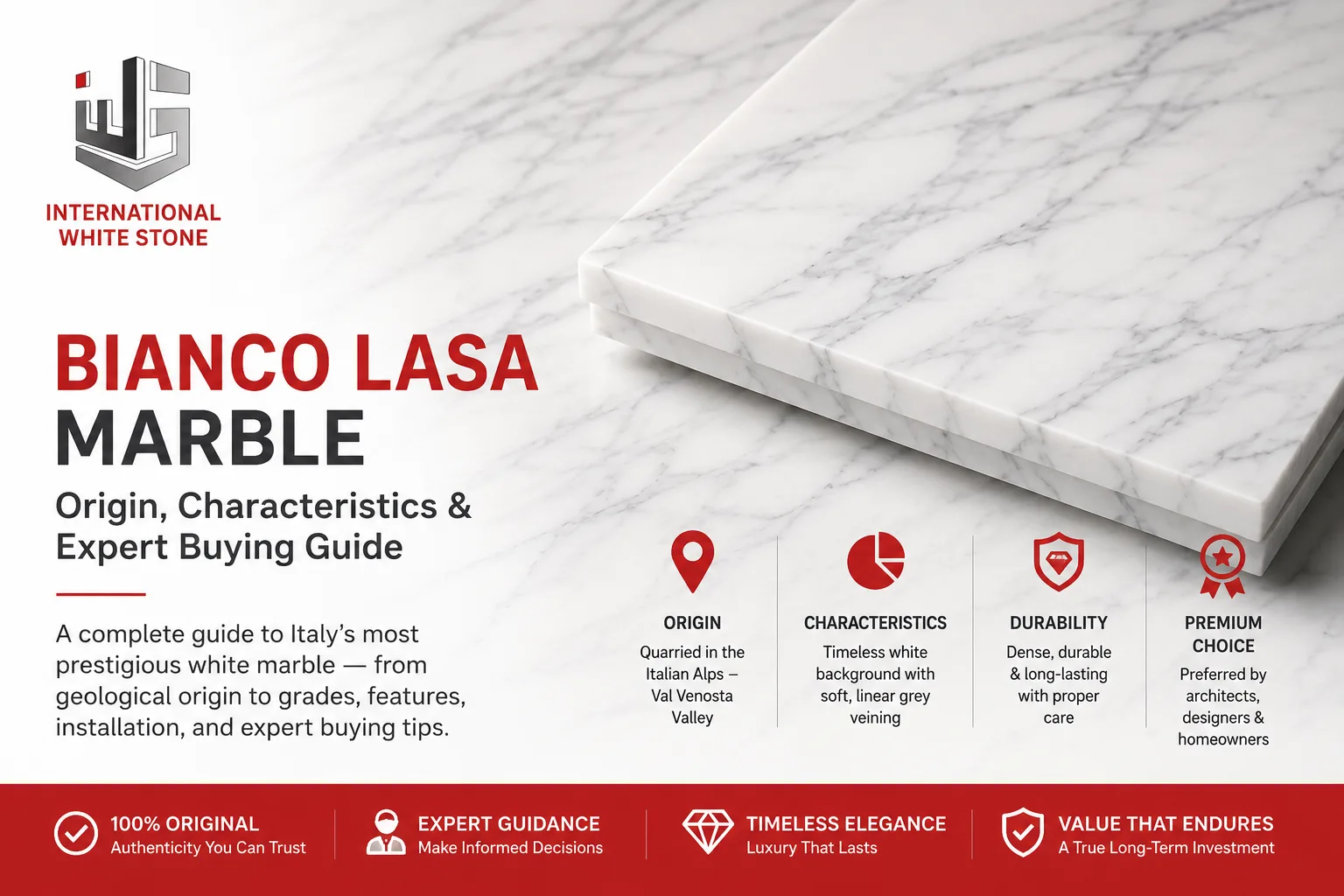
Introduction
Bianco Lasa marble is among the most coveted natural stones on earth and for good reason. Quarried from a single source high in the Italian Alps, this rare white marble has shaped sculptures, adorned palaces, and defined luxury interiors for centuries. Yet today’s market is flooded with imitations. Knowing how to identify original Bianco Lasa marble, understand its unique properties, and make an informed purchase decision can mean the difference between a lifetime investment and a costly mistake.
This guide covers everything from the geological story behind the stone to the specific grades available, practical installation advice, and a clear framework for sourcing authentically.


What Is Authentic Bianco Lasa Marble?
Bianco Lasa marble is a metamorphic white marble extracted exclusively from the Laaser Tal Valley in the village of Laas (Lasa in Italian), located in South Tyrol in northern Italy. The name itself is geographic Bianco means white in Italian, and Lasa refers directly to its village of origin.
What separates authentic Bianco Lasa from the dozens of white marbles sold under similar names is a combination of geological rarity, mineral purity, and a single-source quarry. Unlike Carrara or Calacatta, which are produced across wider regions, genuine Bianco Lasa comes from one quarry alone.
The Geological Story: 400 Million Years in the Making
The formation of Bianco Lasa marble is a story of deep geological time:
- Marine sedimentation: Around 400 million years ago, marine organisms accumulated at the ocean floor. Gravity compressed these organic remains into beds of calcium carbonate crystals.
- Limestone formation: As ancient seas gradually evaporated, the compressed deposits transformed into limestone beds.
- Metamorphic transformation: Intense heat and pressure from within the earth recrystallised the limestone into marble a process called metamorphism.
- Alpine uplift: The movement of tectonic plates across southern Europe caused the ancient seabed to rise, forcing the marble upward into what is now the Alps.
- Current elevation: Today, the Bianco Lasa deposit sits approximately 1,567 metres above sea level. The white patches visible on the mountain faces from a distance are not snow they are exposed marble.
This extraordinary geological journey is precisely why the stone has such extreme mineral density, purity, and structural integrity.
Bianco Lasa Marble Origin and Characteristics
Understanding the defining characteristics of Bianco Lasa marble is essential for both designers and buyers. The stone has a distinct physical and visual profile that sets it apart from any substitute.
Visual Characteristics
- Base colour: Stark, pure white one of the whitest natural marbles available
- Veining: Subtle grey, soft gold, or blue-grey veins depending on the grade
- Translucency: Higher than average for marble light penetrates the surface, giving it a luminous, almost glowing quality
- Surface texture: Fine-grained and uniform, ideal for both polished and honed finishes
Physical Characteristics
| Property | Value |
|---|---|
| Hardness (Mohs) | 3–4 |
| Density | ~2.71 g/cm³ |
| Water absorption | Very low |
| Frost resistance | Excellent |
| Compressive strength | High |
The low water absorption and exceptional frost resistance are direct results of the stone’s dense crystalline structure a product of those 400 million years of geological pressure. This makes Bianco Lasa one of the very few white marbles genuinely suited for exterior applications.
Why It Doesn’t Yellow Over Time
Most white marbles yellow with age due to iron oxide content. Bianco Lasa marble has an exceptionally low iron content, which means it retains its cold, pure white colour over decades even when exposed to UV light, moisture, and temperature fluctuation.
Why Bianco Lasa Marble Is Considered Premium Italian Marble
Several converging factors justify the premium status of Bianco Lasa marble.
1. Single-source exclusivity No other quarry on earth produces this stone. The finite nature of the deposit makes each slab genuinely rare.
2. Geological purity The mineral composition is unusually consistent exceptionally high calcite content with minimal impurities. This translates directly into visual uniformity and long-term stability.
3. Exceptional durability for a white marble Most white marbles are avoided in high-traffic or exterior applications because of porosity and frost sensitivity. Bianco Lasa performs reliably in both, making it far more versatile than competitors.
4. Centuries of proven application The marble has been used in some of Europe’s most significant architectural and sculptural works. This is not a modern marketing story it is a documented historical record.
5. Generational craftsmanship The quarrying and processing tradition in Laas spans multiple generations. The blocks are extracted, bathed in Alpine meltwater, and cut to 20mm international standard thickness using precision machinery operated by craftspeople who have worked with this specific stone for their entire careers.
How to Identify Original Bianco Lasa Marble
The market for white marble is saturated with misrepresented products. Stones from Greece, Turkey, China, and other regions are frequently sold under the Bianco Lasa name. Here is how to distinguish the genuine article.
5 Ways to Verify Authenticity
1. Ask for origin documentation Authentic Bianco Lasa slabs can be traced to the Laaser Tal quarry. Request a certificate of origin or provenance documentation from the supplier.
2. Examine the veining carefully Genuine Bianco Lasa has soft, delicate veining typically subtle grey or pale gold. Bold, dramatic veining is characteristic of other Italian marbles like Calacatta. If the veins are thick and dark, be sceptical.
3. Check the whiteness Authentic Bianco Lasa has a cool, blue-tinged white not a warm cream. If the stone has a warm or yellowish cast, it is likely a different variety.
4. Test for translucency Hold a strong light behind a thinner slab. Bianco Lasa will transmit light evenly across the surface due to its crystalline density. This is a characteristic that substitutes rarely replicate.
5. Work with curated suppliers The safest approach is purchasing through established suppliers who travel directly to the quarry, select blocks in person, and provide verifiable documentation. Volume importers purchasing through intermediaries cannot guarantee this traceability.
Available Grades of Authentic Bianco Lasa Marble
Bianco Lasa is not a single homogenous product. The quarry yields several distinct grades, each with a characteristic veining pattern:
- Laas Bianco Authentico – the purest expression; minimal veining, maximum whiteness
- Laas Oro Authentico – warm gold veining across a white base; elegant and distinctive
- Laas Eterno Authentico – classic grey veining; timeless and versatile
- Laas Superio Authentico – premium grade with refined, consistent patterning
- Laas Blu-Gretto Authentico – subtle blue-grey veining; contemporary and refined
- Laas Gretto Authentico – deeper grey veining; dramatic contrast while retaining white base
Each grade is suitable for different design contexts. The Bianco and Eterno grades suit minimalist, Japandi, or Scandinavian interiors. The Oro grade pairs beautifully with brass fixtures and warm-toned wood. Blu-Gretto works exceptionally well in bathrooms and wet areas.
Authentic Bianco Lasa Marble for Luxury Home Interiors
Bianco Lasa marble is versatile enough for nearly every interior application, yet distinctive enough to anchor a room entirely on its own.
Recommended Applications
Flooring Bianco Lasa performs exceptionally well as flooring. Its density resists wear, and its low porosity means liquid spills are less likely to penetrate. Polished finishes amplify its luminosity; honed finishes reduce slip risk and give a more matte, contemporary feel.
Wall cladding Large-format slabs used for wall cladding are where Bianco Lasa’s translucency truly becomes visible. When backlit a popular contemporary technique the stone glows with a warm internal light.
Kitchen countertops and islands The low iron content makes Bianco Lasa more resistant to staining than many white marbles. With appropriate sealing, it performs well in kitchen environments. Avoid aggressive acidic cleaners that can etch the surface.
Bathrooms Both floor and wall applications in wet areas are suitable given the stone’s low water absorption. Honed finishes are preferred for shower floors.
Feature walls and fireplaces A single slab of Laas Oro or Bianco Authentico behind a fireplace or as a feature wall creates a focal point that requires nothing else to complete the room.
Design Tips from Experienced Specifiers
- Match grades to light conditions. In darker rooms, Bianco Authentico or Eterno maximises light reflection. In bright, south-facing rooms, the Gretto grades add depth without competing with natural light.
- Use large formats. Bianco Lasa’s veining is subtle the impact grows with slab size. Book-matching two slabs creates a symmetrical, butterfly-wing effect.
- Specify thickness correctly. The international standard of 20mm provides structural reliability for flooring; 10–12mm is acceptable for wall cladding.
- Seal before grouting. Apply a penetrating sealer before installation to prevent grout and adhesive staining the edges.
Pros and Cons of Bianco Lasa Marble
Pros
- Exceptional whiteness that does not yellow over time
- Frost-resistant and suitable for exterior use
- Dense, low-porosity structure
- Highly versatile flooring, walls, countertops, sculpture
- Backed by centuries of documented use
- Available in multiple distinctive grades
Cons
- Premium price point relative to other white marbles
- Limited supply due to single-quarry origin
- Requires professional installation to avoid cracking during cutting
- Surface requires sealing and routine maintenance like all natural stone
- High demand means widespread counterfeiting in the market
Expert Recommendation: What to Prioritise When Buying
Having worked with natural stone selection at a professional level, the single most important factor in purchasing Bianco Lasa marble is supply chain transparency. The stone’s rarity creates economic incentive to misrepresent substitutes.
Before committing to a supplier, ask these five questions directly:
- Can you provide a certificate of origin tied to the Laaser Tal quarry?
- Are slabs available in matched pairs for book-matching?
- What standard thickness are slabs cut to and on what machinery?
- Can I inspect the full slab before purchase, not just a sample tile?
- What sealing and finishing treatment has been applied, if any?
Suppliers who cannot answer these questions confidently are unlikely to be supplying genuine material.
Additionally, visit the showroom if one is available. Authentic Bianco Lasa marble has a presence that photographs rarely capture the translucency, the cool whiteness, and the tactile density are qualities you perceive in person, not on screen.
Conclusion
Bianco Lasa marble is not simply another white stone. Its geological rarity, single-source origin, exceptional physical properties, and centuries of use in the world’s most prestigious architectural contexts place it in a category of its own. Understanding what authentic Bianco Lasa marble actually is its origin in the Alps, its characteristic veining grades, its superior frost resistance, and the very real risk of substitution in today’s market gives buyers the knowledge they need to invest wisely.
Whether you are specifying a flooring project, a kitchen countertop, or a full interior scheme, Bianco Lasa marble delivers a combination of beauty, longevity, and material integrity that no substitute can match.
Why Choose IW Stone?
At IW Stone, we supply premium Lasa White Marble, Vietnam White Marble in India, and selected Italian Marble with assured quality and expert guidance for every project.
You can connect with us through:
Company: International White Stone (IW Stone)
Address: Khasra No. 9/1, Plot No. 4, Makrana Road, Industrial Area, Madanganj Kishangarh, Ajmer, Rajasthan 305801
Phone: +91 9555533636 / +91 8875533636
Email: sales.@iwstone.com
Frequently Asked Questions
Q1: What makes Bianco Lasa marble different from other white marbles? Bianco Lasa marble comes from a single quarry in the village of Laas in South Tyrol, Italy making it geologically unique. Unlike most white marbles, it has extremely low iron content (preventing yellowing), high density, very low porosity, and exceptional frost resistance. These combined properties make it suitable for both interior and exterior applications, which is rare for white marble.
Q2: Why is Bianco Lasa marble so expensive? The price reflects genuine scarcity, not just branding. Only one quarry produces authentic Bianco Lasa. Each block requires multi-generational expertise to extract and cut to international standard thickness. The stone’s performance properties frost resistance, low porosity, non-yellowing also reduce long-term maintenance costs, making the investment economically rational over a building’s lifespan.
Q3: How can I tell if Bianco Lasa marble is genuine? Ask for a certificate of origin traceable to the Laaser Tal quarry. Examine the whiteness it should be cool and blue-tinged, not warm or creamy. The veining should be subtle (fine grey or gold), not bold or dramatic. Genuine slabs show translucency when backlit. Work with suppliers who travel to the quarry and select blocks directly.
Q4: Can Bianco Lasa marble be used outdoors? Yes it is one of the very few white marbles reliably suitable for outdoor use. Its dense crystalline structure gives it excellent frost resistance, and its low water absorption prevents the freeze-thaw damage that destroys more porous stones. Exterior terraces, facade cladding, and pool surrounds are all established applications.
Q5: What are the different grades of Bianco Lasa marble? The quarry yields six distinct grades: Bianco Authentico (purest white, minimal veining), Oro Authentico (gold veining), Eterno Authentico (grey veining), Superio Authentico (refined premium grade), Blu-Gretto Authentico (blue-grey veining), and Gretto Authentico (deeper grey contrast veining). Each suits different design contexts and lighting conditions.