


Vietnam Marble: Everything You Need to Know Before You Buy

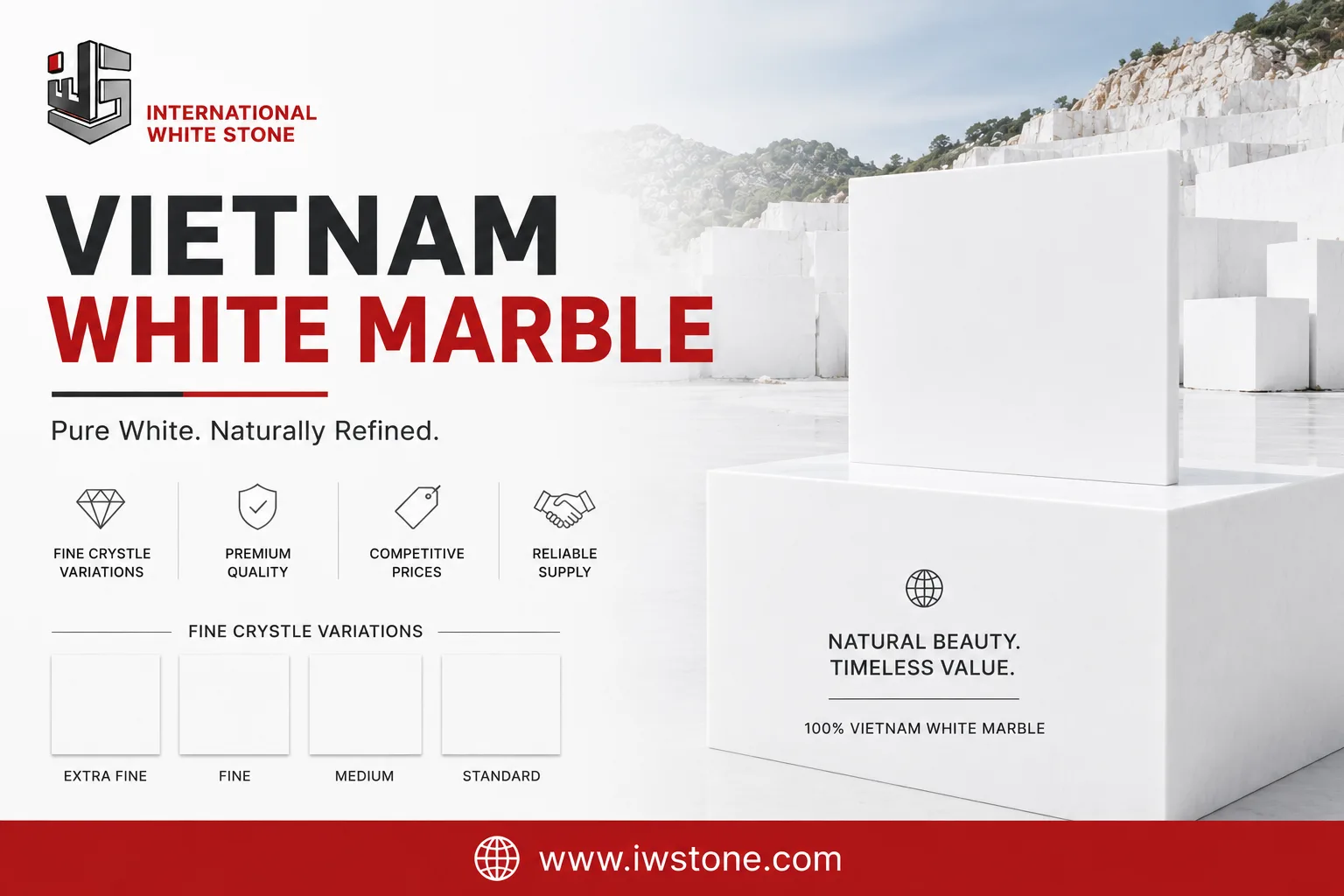
Walk into any high-end lobby, hotel facade, or luxury villa these days, and there’s a good chance the pale, glowing stone underfoot has travelled all the way from the hills of northern Vietnam. Vietnam marble has quietly become one of the most talked-about natural stones in the interior design world, and for good reason — it combines a clean, almost snow-like white base with a price tag that’s far easier on the wallet than its Italian cousins.
If you’ve been searching for “Vietnam marble” and landed here wondering whether it’s actually any good, how it stacks up against Makrana marble, or what it costs, this guide from IW Stone walks through all of it in plain language. As a marble dealer and manufacturer with our own processing facilities in both Kishangarh (Rajasthan) and Vietnam, we source, cut, and finish this stone ourselves — so what follows is based on what we actually see coming through our own units, not just secondhand market chatter.
Where Does Vietnam Marble Actually Come From?
Yes — Vietnam has a genuine, well-established marble industry, and it isn’t a recent discovery. The stone is quarried mainly in two regions of the country. Up north, in the Luc Yen district of Yen Bai province, you’ll find some of the whitest and most crystalline deposits, occasionally even turning up alongside ruby formations in the same rock beds. Further south, in Quy Hop district of Nghe An province, smaller quarries and cutting units produce material that’s more commonly sold as tiles and cut-to-size pieces rather than large slabs.
Because the blocks extracted in Vietnam tend to run on the smaller side compared to European quarries, big monolithic slabs are available but less common — most factories work efficiently with mid-sized blocks, which keeps processing costs (and therefore final prices) competitive.
Interestingly, several Indian stone companies have invested directly in Vietnamese quarries and processing units over the years, which explains why Vietnam marble shows up so prominently in Indian showrooms and price lists today. IW Stone is one of them — we run a manufacturing facility in Vietnam alongside our Kishangarh unit, which lets us control quality from the block stage right through to the finished, polished slab, rather than buying pre-cut material through multiple middlemen.
Is Vietnam Marble Good? A Realistic Look
Here’s the honest answer: yes, within its category, Vietnam marble is genuinely good — but “good” depends on what you’re comparing it to.
What it does well:
- Brightness. The best grades come remarkably close to the pure, glassy white of Macedonian Sivec marble, which is a serious compliment in the stone world.
- Crystal structure. Because the marble formed from limestone under intense heat and pressure, its crystals recrystallized into a dense, sugary texture that takes a high polish beautifully.
- Versatility of finish. Beyond the classic polished look, Vietnam marble also takes honed, bush-hammered, sandblasted, and aged finishes well, so it isn’t limited to just glossy floors.
- Value for money. It delivers a luxury white-marble appearance at a fraction of what Carrara or Statuario would cost.
Where it’s more average:
- Like most marbles, it’s a calcium-carbonate stone, so it’s still vulnerable to acid etching from lemon juice, vinegar, or harsh cleaners, and it needs periodic sealing.
- Veining consistency can vary more between batches than with tightly controlled Italian quarries, since Vietnamese blocks are smaller and sourced from multiple pits.
For flooring, wall cladding, staircases, and decorative work, it performs very well. For heavy-use kitchen countertops exposed to acidic spills daily, it behaves like any other marble — beautiful, but not indestructible — so sealing and basic care matter.
Vietnam Marble vs. Makrana Marble: What’s the Real Difference?
This comparison comes up constantly, especially for buyers in India choosing between an imported and a homegrown option.
| Vietnam Marble | Makrana Marble | |
|---|---|---|
| Origin | Yen Bai & Nghe An provinces, Vietnam | Makrana, Rajasthan, India |
| Historical significance | Growing export industry since the 2000s | Used in the Taj Mahal; centuries-old quarrying tradition |
| Whiteness | Very bright, sometimes near-flawless white | Naturally white with a slightly warmer, softer tone |
| Crystal size | Often larger, more translucent crystals | Finer, tightly packed crystal structure |
| Durability | Good, standard marble hardness | Historically praised for exceptional density and longevity |
| Typical price (India) | Generally lower per sq. ft. | Often priced higher, especially top grades |
| Best suited for | Flooring, cladding, decorative projects, budget-conscious luxury | Heritage-style homes, temples, premium flooring where legacy matters |
In short: Makrana marble carries centuries of proven durability and heritage value (it’s literally the stone the Taj Mahal is built from), while Vietnam marble offers a comparably bright, elegant white look at a more accessible price point for modern homes and commercial projects. Neither is objectively “better” — it comes down to budget, the exact shade you want, and whether heritage pedigree matters to your project.
At IW Stone, we stock both — our Vietnam White Marble and Makrana White Marble ranges are sourced and processed in-house, so if you’re on the fence, our team can walk you through physical samples of both before you commit.
What Does Vietnam Marble Cost?
Pricing varies depending on the grade, slab size, thickness, finish, and which supplier you’re buying from, but as a general reference point in the Indian market, Vietnam white marble typically starts around ₹500 per square foot onwards, with premium, near-flawless grades and larger book-matched slabs priced higher. Commercial-grade material with more visible veining or movement usually sits toward the lower end of the range.
A few things that push the price up or down:
- Grade/purity — the whiter and more flawless the slab, the higher the cost.
- Slab size — larger, book-matched slabs command a premium over smaller cut-to-size tiles.
- Thickness — IW Stone supplies Vietnam marble from 10mm up to 100mm; thicker slabs for staircases and heavy-use flooring cost more per square foot.
- Finish — polished is standard; specialty finishes like honed, bush-hammered, or antique add to processing costs.
Because prices shift with market demand and exchange rates, we’d always recommend getting a current, written quote rather than relying on numbers you saw a year or two ago. You can check live pricing and request a quote on our Vietnam White Marble product page, or contact our team directly for bulk/project rates.
Common Uses of Vietnam Marble
Thanks to its bright tone and workability, Vietnam marble shows up in:
- Flooring for homes, hotels, and commercial lobbies
- Wall cladding and facades
- Staircases and balustrades
- Countertops and vanity tops (with proper sealing)
- Sculptures and decorative carving, which remains a major use within Vietnam’s domestic market
- Furniture accents like tabletops and inlays
A Few Tips If You’re Buying Vietnam Marble
- Ask to see the actual slab or a large sample, not just a small swatch — veining and tone can vary noticeably between blocks.
- Check the grade classification your supplier uses; “premium” and “commercial” grades can differ significantly in price and appearance.
- Confirm the finish and thickness match your application — 16–18mm is standard for flooring, but heavier use areas may need thicker slabs.
- Factor in sealing and maintenance into your long-term cost, since this is what keeps any marble surface looking its best for years.
- Compare quotes across a couple of suppliers, since Vietnam marble pricing isn’t as standardized as branded Italian stones.
Frequently Asked Questions
Is Vietnam marble good?
Yes. The better grades rival premium white marbles like Carrara in brightness and take a high polish well, while costing noticeably less. It’s a genuine natural stone with the same general care needs as any marble — it just isn’t the most scratch- or acid-resistant option on the market, so sealing and sensible cleaning matter.
What is the difference between Makrana marble and Vietnam marble?
Makrana marble is quarried in Rajasthan, India, and has centuries of proven durability behind it — it’s the stone the Taj Mahal was built from. Vietnam marble is quarried in Yen Bai and Nghe An provinces, tends to be brighter and more uniformly white, and is generally priced lower per square foot. Makrana suits heritage-style and temple projects; Vietnam marble suits modern homes and commercial spaces on a tighter budget.
Is there marble in Vietnam?
Yes, Vietnam has a well-established marble industry, with major quarries around Luc Yen (Yen Bai province) in the north and Quy Hop (Nghe An province) further south. It has exported white marble internationally for over two decades now.
What is the price of Vietnam marble?
At IW Stone, Vietnam white marble starts at ₹500 per square foot onwards, with the final price depending on grade, slab size, thickness, and finish. Get an accurate, current quote through our Vietnam White Marble product page or by contacting our team directly.
Is Vietnam marble suitable for kitchen countertops?
It can be, provided it’s sealed properly and resealed periodically. Like all marbles, it’s sensitive to acidic spills (lemon, vinegar, wine), so it suits homeowners who don’t mind the occasional maintenance that comes with natural stone.
How is Vietnam marble different from granite?
Marble and granite are different rock types altogether. Vietnam marble is a metamorphic, calcium-carbonate stone with a softer, more luminous look, while granite is an igneous stone that’s harder and more resistant to scratching and acid — but doesn’t have the same soft, classic white appearance marble is prized for.
Final Thoughts
Vietnam marble has earned its place as a genuinely solid choice for anyone chasing a bright, elegant white-stone look without paying Italian-marble prices. It’s not trying to replace heritage stones like Makrana or Carrara — it’s carving out its own space as a high-value, versatile option for modern flooring, cladding, and decorative projects. If you go in with realistic expectations about marble care in general and buy from a supplier who’s transparent about grading, it’s a stone that can genuinely elevate a space for years to come.
Why Buy Vietnam Marble From IW Stone
IW Stone has spent over a decade in the marble trade, and we’re one of the few Kishangarh-based dealers with our own processing facility in Vietnam alongside our Rajasthan unit — meaning the slab you order is cut and finished under our own quality checks from block to polish, not passed through several unrelated middlemen. We supply cut-to-size slabs from 10mm to 100mm thickness, in polished, honed, and specialty finishes, for residential, commercial, and export projects.
Company: International White Stone (IW Stone)
Address: Khasra No. 9/1, Plot No. 4, Makrana Road, Industrial Area, Madanganj Kishangarh, Ajmer, Rajasthan 305801
Phone: +91 9555533636 / +91 8875533636
Email: sales.@iwstone.com
We provide direct supply at the best price, ensuring premium quality and timely delivery worldwide.
Whether you need marble for a residence, commercial project or export requirement, IW Stone helps you choose the right solution in the Vietnam Marble journey.